Showing posts with label Money. Show all posts

How to Increase Adsense Clicks on Your Website

Friday, September 11, 2009

How to Increase Adsense Clicks on Your Website

Items You Will Need:Adsense account with GoogleProfessional websiteStep One: Get an 800 Number That WorksThe first investment you should make, for around 100 bucks a month is an 800 number. Having an 800 number clearly displayed on your website is going to build trust with potential buyers. Even if they don't buy your specific product, they're more likely to click the adsense ads on your site if they believe you're a professional, instead of a fly by night trying to get rich quick scheme.Step Two: Get a Real Street AddressNext in a clear location on your landing page put a street address. Don't use a PO Box address. Again, this builds trust with your visitors, who will then be more likely to click adsense ads.Step Three: Display Affiliations and AccreditationsGo ahead and list yourself with the BBB, get a business license and process credit cards for your website. Display this information on your website very clearly. Don't make someone have to hunt for your information but have it proudly and clearly displayed.Step Four: Show Trust in Your VisitorsDitch the CAPTCHA feature of your business website. You expect visitors to trust you, so you should trust them. You'll find more visitors will click your adsense ads if you show trust in them as well.Step Five: Ditch the Clear Button and Put an Adsense Add InsteadWith your order form button, ditch the clear button. If a person is undecided after they get through your order form, they're likely to hit some button. You want them clicking an adsense ad or the submit button to order a product instead of the clear button.Step Six: Provide Text on Your Website Relevant to Your Product
READ MORE - How to Increase Adsense Clicks on Your Website

How to Increase Click Earnings on your Website

How to Increase Click Earnings on your Website


Know your audience. Research your audience. Find out about their wants, needs and goals. Why are they seeking your product or services?
Step 2
Check out the competition. Look over their websites. What types of pay-per-clicks ads do they have? What content do they have on their pages, and how are they marketing their product? You may find a tip or two that will help with your efforts.
Step 3
Find the right keywords. Keywords are what your visitors type in when they search. The right keywords optimize and bring more visitors to your site. The key to this is, again, know your audience. For example, if your site is about classic cars, you’ll need to very lightly sprinkle your pages with terms that people will use when searching for information about classic cars.
Step 4
Continually track your results. Search engines have tracking options that allow you to monitor keyword performance, so take advantage of it. This way you get an idea of which keywords work and which don’t and can readjust.
Step 5
Promote your site. Your address should appear at the bottom of your business cards and brochures. It should also be at the bottom of every e-mail you send, even if it's a personal site. Get friends to add you to their personal sites, and if they are on Facebook or Myspace, ask them to add you to that also. Do whatever it takes to get your website out there because the more people that visit your site, the greater your pay-per-click earning potential.
Step 6
Test and retest your ads regularly. Track how a specific ad performs over a period of time. Get rid of the poor performing ads and replace with new ones.
READ MORE - How to Increase Click Earnings on your Website

Kalyan Banks | Finance | Finance Consultants |Insurance Consultants

Sunday, September 6, 2009


Banks | Finance | Finance Consultants |Insurance Consultants

BANKS

BANK OF BARODA - Tisgaon Naka, Balaji Apt., Tisgaon, Kalyan (E)
0251-2333902
CANARA BANK - Mohammed Ali Chowk, Kalyan (W)
0251-2313359
DENA BANK - Plot # 1962 / 1963, Shivaji Chowk, Kalyan (W)
0251-2203905
HDFC BANK - # 1-7, Plot # 2A, Santoshi Mata Rd., Rambaug Lane, Kalyan (W)
0251-2301196
ICICI BANK - Guru Gobind House, Opp. Purnima Theatre, Murbad Road, Kalyan (W) - 421301
0
INDIAN BANK - Zojwala Shopping Centre, Agra Rd., Kalyan
0251-2207949
INDIAN OVERSEAS BANK - R. P. Rd., Bajarang Apt., Kalyan (W)
0251-2326051
KONKAN BANK - Konkan Bank House, Dudh Naka, Kalyan (W)
0251-2207331
STATE BANK OF INDIA - Kalyan Murbard Road, Kalyan (W)
0251-2208744, 2208765
THE BANK OF RAJASTHAN LTD. - S-5, Lokgram, Netivli, Kalyan (E)
0251-2356088
THE KALYAN JANATA BANK - Utekar Palace, Durga Mata Mandir Rd., Kalyan (E)
0251-2331120 / 2337861
THE KALYAN JANATA SAHAKARI BANK - Ashirwad Rambaug Lane - 4, Murbad Rd., Kalyan
0251-2211570
THE NATIONAL CO-OP.BANK - Sheetal Complex, Gr. Floor, Opp. Post Off., Kalyan (E)
0251-2338886 / 2331989
THE SANGLI BANK LTD. - Harihar Timber Complex, Opp. Subhash Maidan, Bazarpeth Rd., Kalyan
0251-2203471
THE SHAMRAO VITHAL BANK - Sai Vihar, Chhatrapati Shivaji Path, Shivaji Chowk, Kalyan
0251-2313786 / 2313479
UNION BANK OF INDIA - Mustafa Manzil,Shankar Rao Chowk, Near Shivaji Chowk, Kalyan (W)
0251-2208796, 2205196
FINANCE, INVESTMENT & LEASING CO.

SHRI LAXMI NAGARI SAHAKARI PATHPADAI MADYATI - Zojowala Shopping Centre, Agra Road, Kalyan.
2205559
FINANCE CONSULTANTS

KOTAK SECURITIES - # 10, Siddhivinayak Arcade, Station Rd., Kalyan
6517594
UTI SECURITIES LIMITED - # 14, Vishwamitra Soc., Lokgram, Kalyan
5675264
UAE X CHANGE - # 1-B, Rani Mansion, Murbad Rd., Kalyan (W)
2201790
ICFAI BRANCH - # 3, Jasraj, Valipeer Road, Kalyan
6450167
MAHINDRA FINANCE - # 8 & 9, Regency Complex, Syndicate, Kalyan
3954897
MANAPPURAM GROUP OF COMPANY - Opp. Dhanwandhari Medical, Katemanivali, Kalyan (E)
2337757
RIZNAD FINANCE CONSULTANTS PVT.LTD - Siddhivinayak Arcade, Oak Baug, Kalyan
3244011
INSURANCE CONSULTANTS

ROYAL CONSULTANT - # 3, Swaranjali Bldg.,Tilak Chowk, Kalyan
9870474029
BIREN A THAKKAR - # 41, Mahavir Shopping Centre, Agra Rd., Kalyan
3241551
BAJAJ ALLIANZ CARE - # 8, Daulat Bldg., Zunzarrao Market Kalyan
9322769831
MANGLANI INSURANCE CONSULATNCY - 2, Dhanlaxmi Construction, Near Birla College, Kalyan (W)
3094999
RAMESH R. WABLE - E-3, Zojwala Complex, Agra Rd., Kalyan
2324892
VAIBHAV SHETE - Yashoda vinayak Sankul, Agra Rd., Kalyan (W)
6695100
LIC AGENTS (INSURANCE ADVISORS)

GOPAL S. HEGDE - # 101, Olympia Tycoon, Opp. B-Ward KDMC, Kalyan
2233542
YASHWANT M. GOSWAMI - Haji Malang Rd., Netivali, Kalyan (W)
9224403632
RAM A. MOTWANI - Nr. Datta Mandir, Murbad Rd., Kalyan
2316439
VINESH HAMIRWASIA - A-5, 402, Gagangiri Enclave, Khadak Pada, Barave Village Road, Kalyan (W)
2280650, 9821008167


READ MORE - Kalyan Banks | Finance | Finance Consultants |Insurance Consultants

Kalyan Banks | Finance | Finance Consultants |Insurance Consultants


Banks | Finance | Finance Consultants |Insurance Consultants

BANKS

BANK OF BARODA - Tisgaon Naka, Balaji Apt., Tisgaon, Kalyan (E)
0251-2333902
CANARA BANK - Mohammed Ali Chowk, Kalyan (W)
0251-2313359
DENA BANK - Plot # 1962 / 1963, Shivaji Chowk, Kalyan (W)
0251-2203905
HDFC BANK - # 1-7, Plot # 2A, Santoshi Mata Rd., Rambaug Lane, Kalyan (W)
0251-2301196
ICICI BANK - Guru Gobind House, Opp. Purnima Theatre, Murbad Road, Kalyan (W) - 421301
0
INDIAN BANK - Zojwala Shopping Centre, Agra Rd., Kalyan
0251-2207949
INDIAN OVERSEAS BANK - R. P. Rd., Bajarang Apt., Kalyan (W)
0251-2326051
KONKAN BANK - Konkan Bank House, Dudh Naka, Kalyan (W)
0251-2207331
STATE BANK OF INDIA - Kalyan Murbard Road, Kalyan (W)
0251-2208744, 2208765
THE BANK OF RAJASTHAN LTD. - S-5, Lokgram, Netivli, Kalyan (E)
0251-2356088
THE KALYAN JANATA BANK - Utekar Palace, Durga Mata Mandir Rd., Kalyan (E)
0251-2331120 / 2337861
THE KALYAN JANATA SAHAKARI BANK - Ashirwad Rambaug Lane - 4, Murbad Rd., Kalyan
0251-2211570
THE NATIONAL CO-OP.BANK - Sheetal Complex, Gr. Floor, Opp. Post Off., Kalyan (E)
0251-2338886 / 2331989
THE SANGLI BANK LTD. - Harihar Timber Complex, Opp. Subhash Maidan, Bazarpeth Rd., Kalyan
0251-2203471
THE SHAMRAO VITHAL BANK - Sai Vihar, Chhatrapati Shivaji Path, Shivaji Chowk, Kalyan
0251-2313786 / 2313479
UNION BANK OF INDIA - Mustafa Manzil,Shankar Rao Chowk, Near Shivaji Chowk, Kalyan (W)
0251-2208796, 2205196
FINANCE, INVESTMENT & LEASING CO.

SHRI LAXMI NAGARI SAHAKARI PATHPADAI MADYATI - Zojowala Shopping Centre, Agra Road, Kalyan.
2205559
FINANCE CONSULTANTS

KOTAK SECURITIES - # 10, Siddhivinayak Arcade, Station Rd., Kalyan
6517594
UTI SECURITIES LIMITED - # 14, Vishwamitra Soc., Lokgram, Kalyan
5675264
UAE X CHANGE - # 1-B, Rani Mansion, Murbad Rd., Kalyan (W)
2201790
ICFAI BRANCH - # 3, Jasraj, Valipeer Road, Kalyan
6450167
MAHINDRA FINANCE - # 8 & 9, Regency Complex, Syndicate, Kalyan
3954897
MANAPPURAM GROUP OF COMPANY - Opp. Dhanwandhari Medical, Katemanivali, Kalyan (E)
2337757
RIZNAD FINANCE CONSULTANTS PVT.LTD - Siddhivinayak Arcade, Oak Baug, Kalyan
3244011
INSURANCE CONSULTANTS

ROYAL CONSULTANT - # 3, Swaranjali Bldg.,Tilak Chowk, Kalyan
9870474029
BIREN A THAKKAR - # 41, Mahavir Shopping Centre, Agra Rd., Kalyan
3241551
BAJAJ ALLIANZ CARE - # 8, Daulat Bldg., Zunzarrao Market Kalyan
9322769831
MANGLANI INSURANCE CONSULATNCY - 2, Dhanlaxmi Construction, Near Birla College, Kalyan (W)
3094999
RAMESH R. WABLE - E-3, Zojwala Complex, Agra Rd., Kalyan
2324892
VAIBHAV SHETE - Yashoda vinayak Sankul, Agra Rd., Kalyan (W)
6695100
LIC AGENTS (INSURANCE ADVISORS)

GOPAL S. HEGDE - # 101, Olympia Tycoon, Opp. B-Ward KDMC, Kalyan
2233542
YASHWANT M. GOSWAMI - Haji Malang Rd., Netivali, Kalyan (W)
9224403632
RAM A. MOTWANI - Nr. Datta Mandir, Murbad Rd., Kalyan
2316439
VINESH HAMIRWASIA - A-5, 402, Gagangiri Enclave, Khadak Pada, Barave Village Road, Kalyan (W)
2280650, 9821008167


READ MORE - Kalyan Banks | Finance | Finance Consultants |Insurance Consultants

How do I use a custom domain name on my blog?

Thursday, September 3, 2009


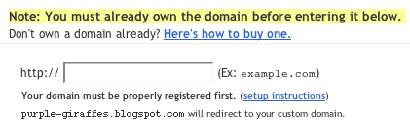
How do I use a custom domain name on my blog?


Note: The setup process for newly-purchased domains may take up to 24 hours.


Publishing on Blog*Spot is the fastest and easiest way to use all of Blogger's great features. (And for free, no less!) If you don't care to have blogspot.com in your blog's address, though, you can get a domain of your own. We'll continue to host all your content as before, but it will be displayed at your new address. (Unlike FTP publishing, which requires you to buy both a domain name and a hosting service.)


Choose and Register Your Domain


The first thing you'll need to do is to choose a domain name, like example.com and register it. You can register domain names from any of a number of different registrars, and you can use .com, .org, .net or any other valid addresses. Remember: you only need to get the domain name; you don't have to pay extra for hosting service. The easiest way to register a domain is to buy your domain directly through Blogger. If you go this route, we'll automatically configure all of your relevant DNS settings and attach your new domain to your existing blog immediately.


Update the DNS Settings


DNS stands for Domain Name System, and a DNS server determines what site a given address takes you to. So far, you have a domain name but none of the servers on the internet know what to do with it yet. To take care of this, you need to do two things:


  • Create a CNAME record for your blog's address, which should be a subdomain of the form www.example.com.


    To create a CNAME record for your domain with the DNS, associating your domain with ghs.google.com. The exact procedure for doing this varies depending on your domain registrar, but you can find instructions for many common registrars here. If yours isn't listed, or if you run into other difficulties, you can contact your registrar directly and they'll be able to help you out.


  • Create 'A' NAME records for your naked domain (blog.com)


    Creating A records for your naked domain is important as it allows Google to redirect people who use in your naked domain name (blog.com) to your blog page (www.example.com). If you do not do this, visitors who leave off the www will see an error page.


    There are four separate A records you will create, and can be done from the same control panel you accessed your CNAME records. Simply point your naked domain (example.com, without the 'www') to each of the following IP addresses:


216.239.32.21
216.239.34.21
216.239.36.21
216.239.38.21


Your DNS setup is now complete!


Update Your Blogger Settings


Almost done! At this point, you have a domain name, and the DNS servers know to direct people to Google when they want to see your blog. But Google hosts lots of blogs, so we have to make sure the right one is associated with this domain. You'll do this on the Settings Publishing tab for your blog in Blogger.


If you're publishing on Blog*Spot, you'll see a link near the top offering to switch you to a custom domain. Go ahead and click that link.


The Blog*Spot Address setting now changes to Your Domain. Fill in the domain you registered, and then save your settings.


Now the only thing left to do is to tell everybody about your new address!


Notes:


READ MORE - How do I use a custom domain name on my blog?

Download Vaada Raha... I Promise Songs - Bollywood

Saturday, August 29, 2009

Download Vaada Raha... I Promise Songs - Bollywood Movie

Vaada Raha... I Promise
>> >>
Vaada Raha

Media Player-128 Kbps

Rab Na Kare

Media Player-128 Kbps

Kubul

Media Player-128 Kbps

Aaj Aasmaan

Media Player-128 Kbps

Rab Na Kare - Slow

Media Player-128 Kbps

Achal Hain Mere Hausle

Media Player-128 Kbps

Vaada Raha - Remix

Media Player-128 Kbps

Vaada Raha - Theme

Media Player-128 Kbps

Flying High - Theme

Media Player-128 Kbps

Lost In Love - Theme

Media Player-128 Kbps

Vaada Raha... I Promise - 128Kbps [Songs.PK]Zip File128 Kbps40.7 Mb
Vaada Raha... I Promise - 320Kbps [Songs.PK]Zip File320 Kbps72.1 Mb
READ MORE - Download Vaada Raha... I Promise Songs - Bollywood

How to Beginners Stock Trading: Basic Stock Terminology

Wednesday, August 26, 2009

How to Beginners Stock Trading: Basic Stock Terminology

Adam W. Porter is a successful investor, and has been trading stocks for over a decade. Adam is the owner of where he offers stock tips and advice through a free newsletter. Learn more about Adam and sign up for his newsletter by visiting http://www.powerfulstocktips.com.

Difficulty: Easy

Instructions

Things You'll Need:

·       In beginners stock trading, knowing the basic terminology is critical. This article covers the most common terms and what they mean.

1.      Step 1

    Stock terminology can get confusing in beginners stock trading. It is not that the terms are misleading, but more because there are so many of them to know. If you take the time to learn a few of these beginners stock trading key words at a time, you’ll be set in no time! Below is a list of the most common terms that you should be familiar with.
    Market / Stock Market / Stock Exchange – An exchange where professional brokers buy and sell stocks. I recommend sticking to the NYSE, Dow Jones, and Nasdaq for beginners stock trading.
    Trading Hours – The time during which stocks can be traded. In the US, trading runs from 9:30am ET to 4:00pm ET.

2.      Step 2

    Market Maker / MM – A firm that conducts the trading of shares between other firms or individuals.
    Ticker Symbol – A unique letter-based symbol used to represent the company’s stock.
    Share – A unit of ownership of a company’s stock.
    Authorized Shares – The total number of shares that a company has.
    Outstanding Shares – Shares that are available to buy or sell in the market.
    Restricted Shares – Shares that cannot be traded for a certain period of time.
    Float – Shares that are available for trade by the investing public.
    Buy – To purchase shares of a company’s stock.
    Sell – To sell shares of a company’s stock.
    Commission – A fee paid to your broker for facilitating a purchase or sale of stock.

3.      Step 3

    Bid – The price at which a broker will buy shares (i.e. a sale of shares would be executed at the Bid price).
    Ask – The price at which a broker will sell shares (i.e. a purchase of shares would be executed at the Ask price).
    Spread – The difference between the Bid and the Ask prices.
    Day Order – An order to buy or sell stock that will be canceled if it does not get filled by the end of the trading day.
    Good Til Canceled / GTC – An order to buy or sell stock that will remain open for 30 to 60 days (varies by broker).
    Limit Order – An order to buy or sell stock that will not go through until the price gets to a specified level, or better.
    Trend – The general direction that a stock is moving…upward or downward.
    Bearish – Describes a stock that is expected to trend downward.
    Bullish – Describes a stock that is expected to trend upward.
    These few terms will give you a good start in http://www.powerfulstocktips.com. It is easier to talk about the stock market if you understand these basic stock terms. Learning them will help in your discussions, your research, and in understanding the helpful tools out there.

Please do not print this email unless it is absolutely necessary.

The information contained in this electronic message and any attachments to this message are intended for the exclusive use of the addressee(s) and may contain proprietary, confidential or privileged information. If you are not the intended recipient, you should not disseminate, distribute or copy this e-mail. Please notify the sender immediately and destroy all copies of this message and any attachments.

WARNING: Computer viruses can be transmitted via email. The recipient should check this email and any attachments for the presence of viruses. The company accepts no liability for any damage caused by any virus transmitted by this email.

www.wipro.com

READ MORE - How to Beginners Stock Trading: Basic Stock Terminology

Stock Information on Auto Manufacturers

Stock Information on Auto Manufacturers

Before buying a stock, investors must analyze the company to make sure that the fundamentals and finances are sound. This is especially true for the auto manufacturers. The auto industry is in a state of turmoil. Several of the manufacturers are restructuring their organizations while others are struggling during the economic decline and reduction in consumer spending. Investors must be sure to analyze an auto manufacturer's stock before making an investment.

    Ford

1.      Ford Motors trades on the New York Stock Exchange using the symbol F. The split adjusted all time low price of Ford's stock was $1.05 in November of 1981. The stock's all time high is $26.21 which it reached in April of 1998. Currently, Ford does not issue a dividend to shareholders.

    General Motors

2.      When General Motors filed for bankruptcy in June of 2009, its stock stopped trading on the New York Stock Exchange. Currently, the assets of General Motors are being controlled by Motors Liquidation which trades over the counter using the symbol MTLQQ.PK.

    Chrysler

3.      Chrysler was purchased by the private equity group Cerberus Capital Management in August of 2007. Chrysler's stock stopped trading when Cerberus bought the majority of the outstanding shares. It is no longer possible for individual investors to buy shares of Chrysler.

    Toyota

4.      Toyota Motor's shares trade on the New York Stock Exchange using the symbol TM. The shares of Toyota reached an all time high of $134.31 in December of 2006. The all time split adjusted low for Toyota's stock was $28.07 in June of 1993. Currently, Toyota pays a quarterly dividend of approximately $0.48 per share.

    Honda

5.      Honda Motors trades on the New York Stock Exchange using the symbol HMC. The all time high for Honda's stock was reached in January of 2007 when it hit $39.33. The split adjusted all time low for Honda was in January of 1991 when it traded at $3.94. Honda currently pays a $0.075 quarterly dividend.

Please do not print this email unless it is absolutely necessary.

The information contained in this electronic message and any attachments to this message are intended for the exclusive use of the addressee(s) and may contain proprietary, confidential or privileged information. If you are not the intended recipient, you should not disseminate, distribute or copy this e-mail. Please notify the sender immediately and destroy all copies of this message and any attachments.

WARNING: Computer viruses can be transmitted via email. The recipient should check this email and any attachments for the presence of viruses. The company accepts no liability for any damage caused by any virus transmitted by this email.

www.wipro.com

READ MORE - Stock Information on Auto Manufacturers

Stock Information on Auto Manufacturers

Stock Information on Auto Manufacturers

Before buying a stock, investors must analyze the company to make sure that the fundamentals and finances are sound. This is especially true for the auto manufacturers. The auto industry is in a state of turmoil. Several of the manufacturers are restructuring their organizations while others are struggling during the economic decline and reduction in consumer spending. Investors must be sure to analyze an auto manufacturer's stock before making an investment.

    Ford

1.      Ford Motors trades on the New York Stock Exchange using the symbol F. The split adjusted all time low price of Ford's stock was $1.05 in November of 1981. The stock's all time high is $26.21 which it reached in April of 1998. Currently, Ford does not issue a dividend to shareholders.

    General Motors

2.      When General Motors filed for bankruptcy in June of 2009, its stock stopped trading on the New York Stock Exchange. Currently, the assets of General Motors are being controlled by Motors Liquidation which trades over the counter using the symbol MTLQQ.PK.

    Chrysler

3.      Chrysler was purchased by the private equity group Cerberus Capital Management in August of 2007. Chrysler's stock stopped trading when Cerberus bought the majority of the outstanding shares. It is no longer possible for individual investors to buy shares of Chrysler.

    Toyota

4.      Toyota Motor's shares trade on the New York Stock Exchange using the symbol TM. The shares of Toyota reached an all time high of $134.31 in December of 2006. The all time split adjusted low for Toyota's stock was $28.07 in June of 1993. Currently, Toyota pays a quarterly dividend of approximately $0.48 per share.

    Honda

5.      Honda Motors trades on the New York Stock Exchange using the symbol HMC. The all time high for Honda's stock was reached in January of 2007 when it hit $39.33. The split adjusted all time low for Honda was in January of 1991 when it traded at $3.94. Honda currently pays a $0.075 quarterly dividend.

Please do not print this email unless it is absolutely necessary.

The information contained in this electronic message and any attachments to this message are intended for the exclusive use of the addressee(s) and may contain proprietary, confidential or privileged information. If you are not the intended recipient, you should not disseminate, distribute or copy this e-mail. Please notify the sender immediately and destroy all copies of this message and any attachments.

WARNING: Computer viruses can be transmitted via email. The recipient should check this email and any attachments for the presence of viruses. The company accepts no liability for any damage caused by any virus transmitted by this email.

www.wipro.com

READ MORE - Stock Information on Auto Manufacturers

How to Beginners Stock Trading: Basic Stock Terminology

How to Beginners Stock Trading: Basic Stock Terminology

Adam W. Porter is a successful investor, and has been trading stocks for over a decade. Adam is the owner of where he offers stock tips and advice through a free newsletter. Learn more about Adam and sign up for his newsletter by visiting http://www.powerfulstocktips.com.

Difficulty: Easy

Instructions

Things You'll Need:

·       In beginners stock trading, knowing the basic terminology is critical. This article covers the most common terms and what they mean.

1.      Step 1

    Stock terminology can get confusing in beginners stock trading. It is not that the terms are misleading, but more because there are so many of them to know. If you take the time to learn a few of these beginners stock trading key words at a time, you’ll be set in no time! Below is a list of the most common terms that you should be familiar with.
    Market / Stock Market / Stock Exchange – An exchange where professional brokers buy and sell stocks. I recommend sticking to the NYSE, Dow Jones, and Nasdaq for beginners stock trading.
    Trading Hours – The time during which stocks can be traded. In the US, trading runs from 9:30am ET to 4:00pm ET.

2.      Step 2

    Market Maker / MM – A firm that conducts the trading of shares between other firms or individuals.
    Ticker Symbol – A unique letter-based symbol used to represent the company’s stock.
    Share – A unit of ownership of a company’s stock.
    Authorized Shares – The total number of shares that a company has.
    Outstanding Shares – Shares that are available to buy or sell in the market.
    Restricted Shares – Shares that cannot be traded for a certain period of time.
    Float – Shares that are available for trade by the investing public.
    Buy – To purchase shares of a company’s stock.
    Sell – To sell shares of a company’s stock.
    Commission – A fee paid to your broker for facilitating a purchase or sale of stock.

3.      Step 3

    Bid – The price at which a broker will buy shares (i.e. a sale of shares would be executed at the Bid price).
    Ask – The price at which a broker will sell shares (i.e. a purchase of shares would be executed at the Ask price).
    Spread – The difference between the Bid and the Ask prices.
    Day Order – An order to buy or sell stock that will be canceled if it does not get filled by the end of the trading day.
    Good Til Canceled / GTC – An order to buy or sell stock that will remain open for 30 to 60 days (varies by broker).
    Limit Order – An order to buy or sell stock that will not go through until the price gets to a specified level, or better.
    Trend – The general direction that a stock is moving…upward or downward.
    Bearish – Describes a stock that is expected to trend downward.
    Bullish – Describes a stock that is expected to trend upward.
    These few terms will give you a good start in http://www.powerfulstocktips.com. It is easier to talk about the stock market if you understand these basic stock terms. Learning them will help in your discussions, your research, and in understanding the helpful tools out there.

Please do not print this email unless it is absolutely necessary.

The information contained in this electronic message and any attachments to this message are intended for the exclusive use of the addressee(s) and may contain proprietary, confidential or privileged information. If you are not the intended recipient, you should not disseminate, distribute or copy this e-mail. Please notify the sender immediately and destroy all copies of this message and any attachments.

WARNING: Computer viruses can be transmitted via email. The recipient should check this email and any attachments for the presence of viruses. The company accepts no liability for any damage caused by any virus transmitted by this email.

www.wipro.com

READ MORE - How to Beginners Stock Trading: Basic Stock Terminology

Basic Information on the Stock Market in India

Basic Information on the Stock Market in India

Picture (Device Independent Bitmap)

The Indian stock market is made up of 22 stock exchanges. The most prominent among these are the Bombay Stock Exchange, National Stock Exchange, and Over the Counter Stock Exchange of India. According to the Securities and Exchange Board of India (SEBI), the regulatory authority, there were 1,680 registered foreign institutional investors (FIIs) in India as of August 13, 2009. Total investments by FIIs for this period amounted to $65.5 billion.

    The Bombay Stock Exchange

1.      Established in 1875, the Bombay Stock Exchange (BSE) is the oldest stock exchange in Asia. BSE ranks number one globally on the basis of the number of companies listed, which is more than 5,500. As of December 31, 2007, market capitalization was $ 1.79 trillion.
You can buy and sell stocks in the BSE via BSEWEBX.com, an internet trading platform, if you are registered with a BSE broker. The BSE index, the SENSEX, consists of 30 stocks. The exchange has a total of 22 indices,12 of which are sector-based.

    The National Stock Exchange

2.      The National Stock Exchange of India (NSE) is the largest securities exchange in the country on the basis of daily turnover (value). On May 19, 2009, the daily turnover was Rs.8.33 billion. Incorporated in 1992, NSE created an advanced automated electronic trading system, accessible from 1,486 locations in India. NSE commenced operations in the wholesale debt market segment in June 1994. The equities segment was operational in November 1994 and the derivatives segment, in June 2000. The exchange is owned by 20 banks and insurance companies. As of January 8, 2008, the S&P CNX Nifty Index was Rs. 1.32 billion. NSE's subsidiaries are the National Securities Clearing Corporation, NSE Infotech Services and NSE.IT (securities technology).
NYSE Euronext, a division of the New York Stock Exchange, has a 5 percent equity stake in NSE.

    Over the Counter Exchange

3.      Established in 1990, Over the Counter Exchange of India (OTCEI) is the only exchange in the country that permits small and mid-sized companies, operational for less than three years, to raise funds in the capital market. It was the first exchange in India to permit market making---a two-way buy/sell order for securities.

    SENSEX Components

4.      The BSE Sensex consists of 30 large-cap companies in a smattering of industries including cement, telecommunications, real estate, banking, IT, construction, automobile, oil, pharmaceuticals, energy and steel. Major companies in the Sensex are Infosys Technologies (also listed in NASDAQ), Reliance, Tata Steel, Tata Power, and Tata Motors, which owns the Jaguar, Land Rover and Range Rover brands.

    NSE 50 Components

5.      The S&P CNX Nifty consists of 50 companies in 21 industries such as cement, telecommunications, pharmaceuticals, banking, automobile, construction, aluminium, oil exploration, gas and finance. Prominent companies are Bharat Heavy Electricals,Bharti Airtel, Cairn India, GAIL (India), Hero Honda Motors, Hindustan Unilever, Housing Development Finance Corporation and Infosys Technologies.

Please do not print this email unless it is absolutely necessary.

The information contained in this electronic message and any attachments to this message are intended for the exclusive use of the addressee(s) and may contain proprietary, confidential or privileged information. If you are not the intended recipient, you should not disseminate, distribute or copy this e-mail. Please notify the sender immediately and destroy all copies of this message and any attachments.

WARNING: Computer viruses can be transmitted via email. The recipient should check this email and any attachments for the presence of viruses. The company accepts no liability for any damage caused by any virus transmitted by this email.

www.wipro.com

READ MORE - Basic Information on the Stock Market in India

Basic Information on the Stock Market in India

Basic Information on the Stock Market in India

Picture (Device Independent Bitmap)

The Indian stock market is made up of 22 stock exchanges. The most prominent among these are the Bombay Stock Exchange, National Stock Exchange, and Over the Counter Stock Exchange of India. According to the Securities and Exchange Board of India (SEBI), the regulatory authority, there were 1,680 registered foreign institutional investors (FIIs) in India as of August 13, 2009. Total investments by FIIs for this period amounted to $65.5 billion.

    The Bombay Stock Exchange

1.      Established in 1875, the Bombay Stock Exchange (BSE) is the oldest stock exchange in Asia. BSE ranks number one globally on the basis of the number of companies listed, which is more than 5,500. As of December 31, 2007, market capitalization was $ 1.79 trillion.
You can buy and sell stocks in the BSE via BSEWEBX.com, an internet trading platform, if you are registered with a BSE broker. The BSE index, the SENSEX, consists of 30 stocks. The exchange has a total of 22 indices,12 of which are sector-based.

    The National Stock Exchange

2.      The National Stock Exchange of India (NSE) is the largest securities exchange in the country on the basis of daily turnover (value). On May 19, 2009, the daily turnover was Rs.8.33 billion. Incorporated in 1992, NSE created an advanced automated electronic trading system, accessible from 1,486 locations in India. NSE commenced operations in the wholesale debt market segment in June 1994. The equities segment was operational in November 1994 and the derivatives segment, in June 2000. The exchange is owned by 20 banks and insurance companies. As of January 8, 2008, the S&P CNX Nifty Index was Rs. 1.32 billion. NSE's subsidiaries are the National Securities Clearing Corporation, NSE Infotech Services and NSE.IT (securities technology).
NYSE Euronext, a division of the New York Stock Exchange, has a 5 percent equity stake in NSE.

    Over the Counter Exchange

3.      Established in 1990, Over the Counter Exchange of India (OTCEI) is the only exchange in the country that permits small and mid-sized companies, operational for less than three years, to raise funds in the capital market. It was the first exchange in India to permit market making---a two-way buy/sell order for securities.

    SENSEX Components

4.      The BSE Sensex consists of 30 large-cap companies in a smattering of industries including cement, telecommunications, real estate, banking, IT, construction, automobile, oil, pharmaceuticals, energy and steel. Major companies in the Sensex are Infosys Technologies (also listed in NASDAQ), Reliance, Tata Steel, Tata Power, and Tata Motors, which owns the Jaguar, Land Rover and Range Rover brands.

    NSE 50 Components

5.      The S&P CNX Nifty consists of 50 companies in 21 industries such as cement, telecommunications, pharmaceuticals, banking, automobile, construction, aluminium, oil exploration, gas and finance. Prominent companies are Bharat Heavy Electricals,Bharti Airtel, Cairn India, GAIL (India), Hero Honda Motors, Hindustan Unilever, Housing Development Finance Corporation and Infosys Technologies.

Please do not print this email unless it is absolutely necessary.

The information contained in this electronic message and any attachments to this message are intended for the exclusive use of the addressee(s) and may contain proprietary, confidential or privileged information. If you are not the intended recipient, you should not disseminate, distribute or copy this e-mail. Please notify the sender immediately and destroy all copies of this message and any attachments.

WARNING: Computer viruses can be transmitted via email. The recipient should check this email and any attachments for the presence of viruses. The company accepts no liability for any damage caused by any virus transmitted by this email.

www.wipro.com

READ MORE - Basic Information on the Stock Market in India

What to Do With Stock When the Market Falls

What to Do With Stock When the Market Falls

Picture (Device Independent Bitmap)

It's important to have a plan for the inevitable stock market declines.

No stock or market goes up forever in a straight line -- and if it does, it probably means it's about to come crashing back down. Stock markets inevitably fall for a variety of reasons. As an investor, it's important to have a plan in place before it happens. Those who can foresee a fall can actually profit on the drop, or at least offset losses, with a simple options strategy. Otherwise, the best choice might be to take advantage of lower prices with new purchases, or simply take the loss and write it off on your taxes.

    Sell Calls

1.      If you're fortunate enough to identify a downtrend in the market just before it happens or early in the decline, one of the best ways to protect your investment is to sell calls. A covered call is the safest and simplest option strategy there is because it only involves selling calls against stock you own. Each 100 shares is equivalent to one options contract. Any call you sell will net you an immediate credit for the proceeds of the sale, and if the call expires worthless, you keep that money. If the call gets exercised, you keep the proceeds of the original option sale, plus the proceeds of your stock, which is sold at the strike price of the call options. The worst-case scenario is that the stock declines more than the proceeds you collect for the options sale, but even so, you're better off than if you hadn't sold the calls. The more accurately you can predict the duration and depth of the decline, the better able you will be at maximizing the proceeds of the option sale by picking the optimum series and strike price. Another benefit of this approach is that you can continue to collect dividends on the stock you own despite having sold calls against it.

    Buy More

2.      If you aren't fortunate enough to have foreseen a decline in the stock market, you can still take advantage of the lower prices by purchasing more shares. This approach requires caution and due diligence, however. While it's believed that stock indexes eventually revert to their long-term averages (a theory called mean reversion), a steep decline in an individual stock can signal a serious change in the company's condition that could prevent a return to higher prices. It's also risky to buy all at once without knowing if the decline has ended. If a company appears to be intact and likely to return to its typically higher prices, it's a good idea to make incremental purchases with the new cash you've allocated to the name. One approach, called dollar-cost averaging, involves buying an equal dollar value of shares over a certain period of time, with more shares being purchased if the price is low and less if it is higher. Another way is to simply decide on a number of shares and buy equal lots of shares until the predetermined quantity is reached. As with covered calls, you continue to collect dividends on stock (assuming the company continues to pay them) and actually capture a higher yield by purchasing at lower prices.

    Take Losses

3.      No one likes to lose money, but one good thing capital losses are good for is offsetting capital gains. If you happen to have significant capital gains in a particular tax period, you might elect to take a loss on stock that has fallen to lower your tax liability. If you choose to do so, however, be sure to consider the IRS wash rule, which could prevent deducting capital losses if they were incurred 30 days before or after the acquisition of substantially identical stock. In other words, you can't take a tax loss on stock that you've held for less than 30 days, and you can't reinvest the proceeds of the sale into the same stock for 30 days after the sale or the loss will be disallowed for tax purposes. Also be aware that if your capital losses exceed your capital gains, you can only deduct the excess up to $3,000 in a single year (the rest can be carried over to future years).

Please do not print this email unless it is absolutely necessary.

The information contained in this electronic message and any attachments to this message are intended for the exclusive use of the addressee(s) and may contain proprietary, confidential or privileged information. If you are not the intended recipient, you should not disseminate, distribute or copy this e-mail. Please notify the sender immediately and destroy all copies of this message and any attachments.

WARNING: Computer viruses can be transmitted via email. The recipient should check this email and any attachments for the presence of viruses. The company accepts no liability for any damage caused by any virus transmitted by this email.

www.wipro.com

READ MORE - What to Do With Stock When the Market Falls


Popular Posts